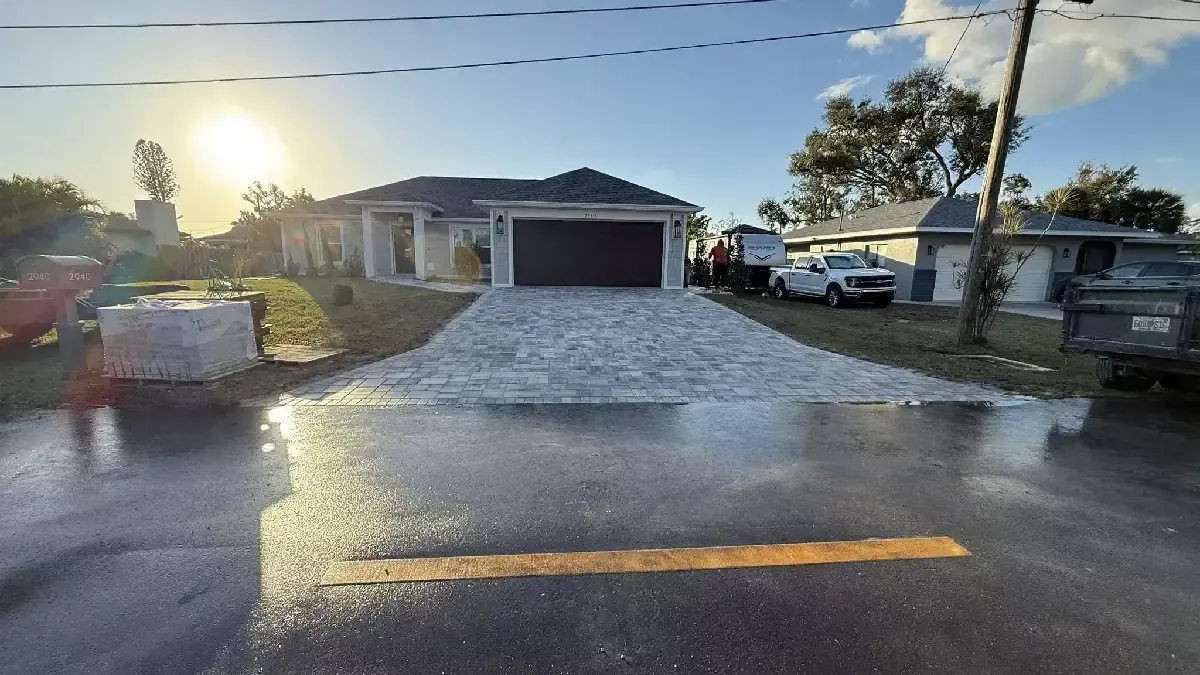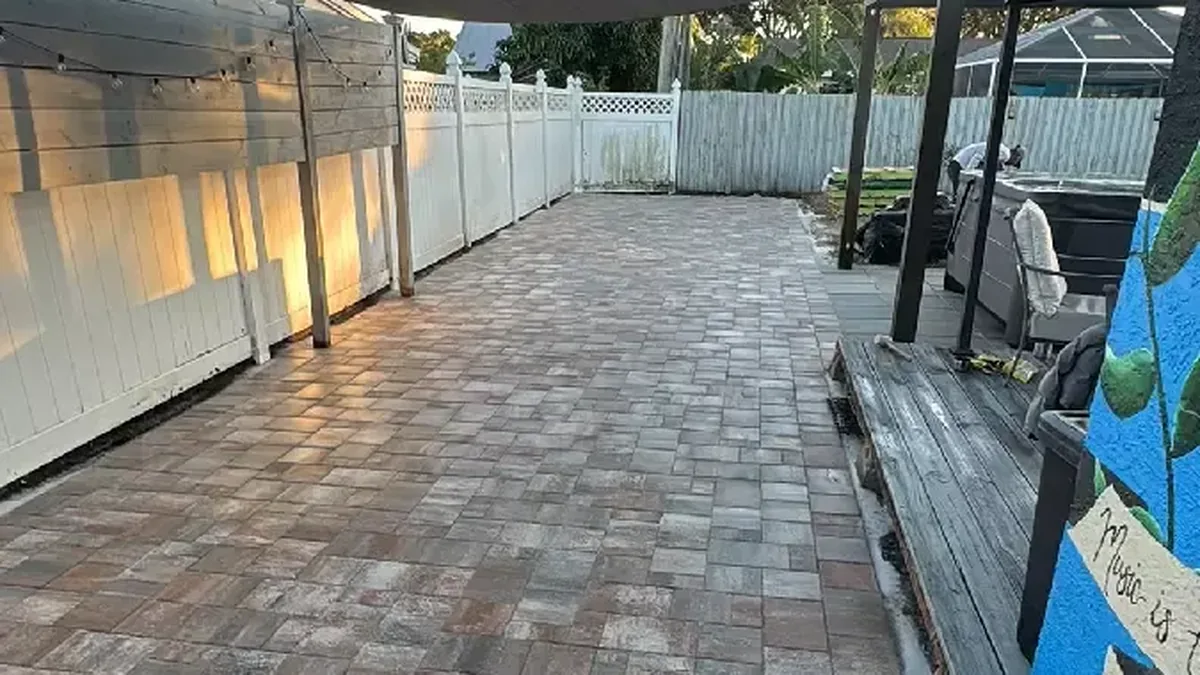
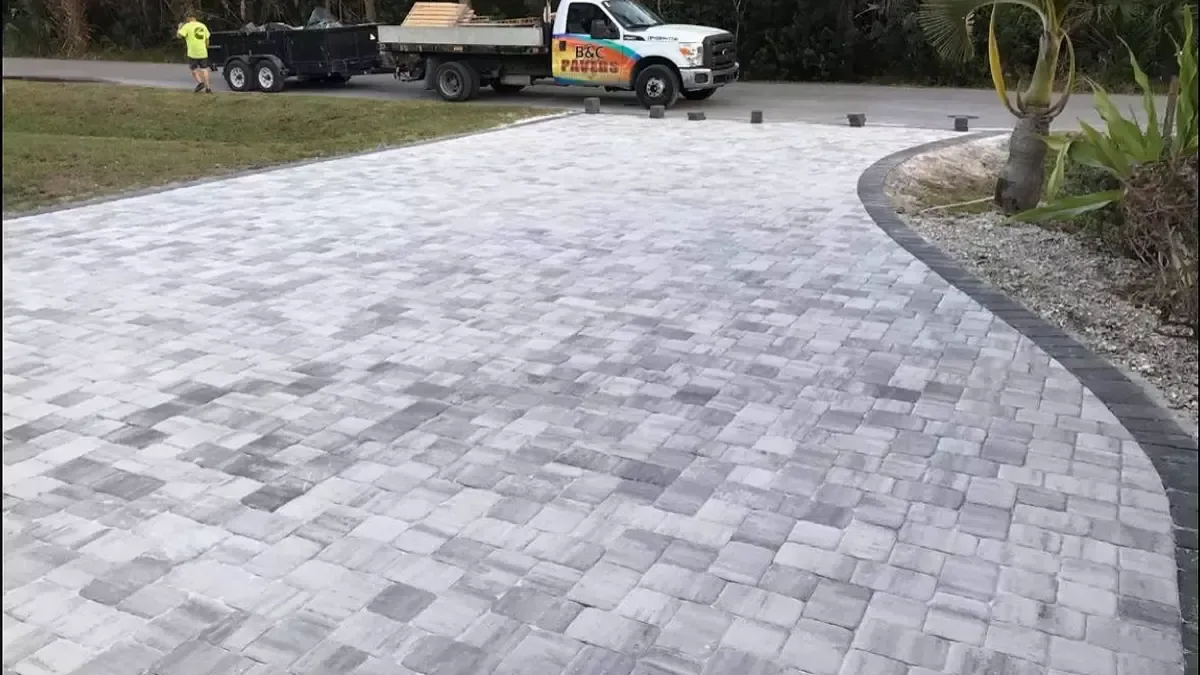
A poured concrete driveway is usually the lower number on install day. A paver driveway handles ground movement better and repairs without leaving a patch you can see from the street. Which one is right for you comes down to how long you plan to own the house and how much a visible repair would bother you.
Here is the honest version of the comparison, including the cases where a slab is the better call.
Ground Movement Is the Real Difference
A poured driveway is one rigid piece. When the ground under it shifts, the slab has nowhere to go, so it cracks. That is the failure mode everyone recognizes, and it is why so many driveways around Sarasota County have a line running corner to corner.
A paver driveway is made of individual units sitting on compacted base sand. When the ground moves slightly, the surface flexes across the joints instead of fracturing. Movement still has to be taken seriously and still has to be dealt with, but it shows up as a dip you can reset rather than a crack you cannot undo.
That is why what goes underneath matters more than the paver you pick. The standard here is a 4-inch total base system, 2 inches of compacted base sand under a 2-inch concrete paver, with depth adjusted as needed for specific site conditions.
What a Repair Actually Looks Like on Each
This is where the two surfaces separate in practice.
On a slab, a crack gives you two choices. Patch it and live with a visible seam in a color that never quite matches, or tear out and repour a section, which produces a different kind of visible seam.
On pavers, the affected units come up, the support underneath gets corrected, and the same pavers go back down. The repaired area is the original material in the original pattern. Nobody who was not there can point to it afterward.
Same story for a stain, an oil drip, or a unit damaged by something dropped on it. One paver gets swapped.
Utility Work Is Easier to Live With
Anyone who has had a plumber or an irrigation crew cut into a concrete driveway knows how that ends. Saw cuts, a patch, and a permanent record of the repair.
When that work happens under pavers, the units in the path are lifted, the trench is dealt with, the support is rebuilt and compacted, and the pavers go back. Older homes and properties with irrigation running under the drive are exactly where this pays off.
Appearance and How Each One Ages
Pavers give you real choices on color, texture, pattern, and border detail, so the driveway matches the house instead of just serving it. A plain slab gives you gray, plus whatever finish or stain gets added on top, and those applied finishes are the part that tends to show wear first.
If a driveway runs into a walkway or a pool area, slip-resistant surface options are available and worth raising at the design stage rather than after installation.
When a Concrete Slab Is the Better Call
Two situations come up often enough to name.
The first is a short hold. If you are selling within a year or two and the existing driveway is failing, the lower up-front number may simply be the right business decision.
The second is a purely utilitarian surface where appearance does not factor in, such as a rear equipment pad or a service area out of sight. Paying for pattern and color nobody will look at is not much of an investment.
What We See When a Cracked Slab Comes Out
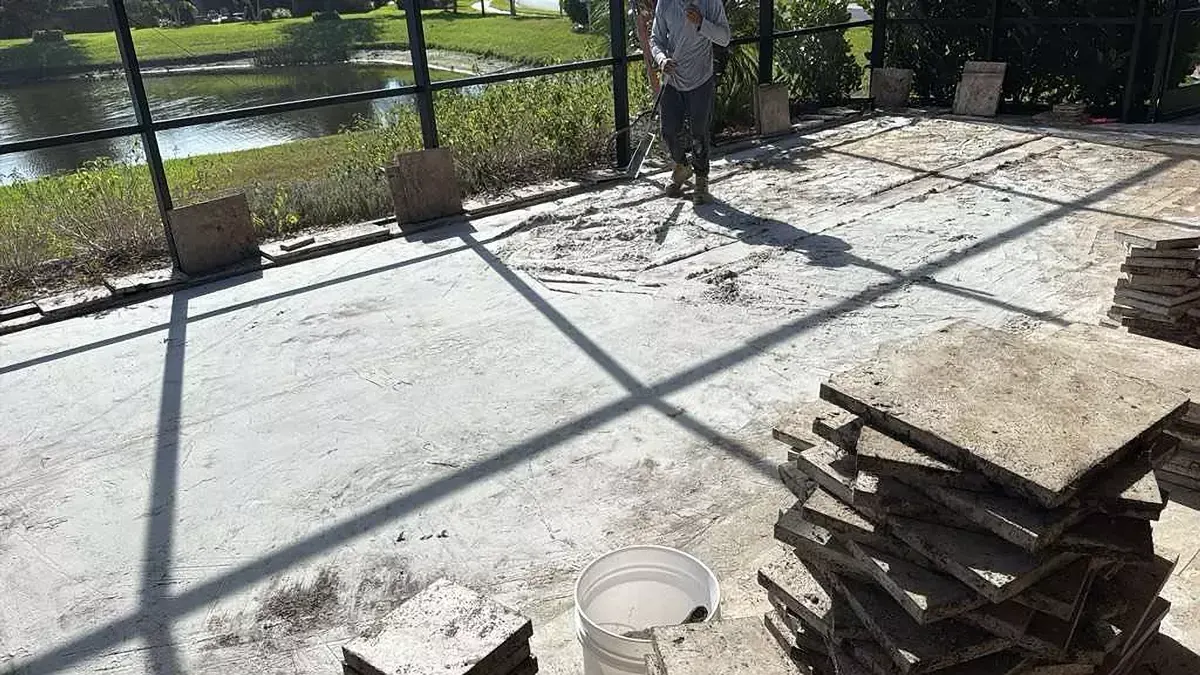
The pattern is consistent enough to be worth mentioning. When a failed slab gets removed and a paver driveway goes in its place, the crack almost always tracks something underneath: a soft area, an old trench line, or water that had been running the same path for years.
So the slab coming out does not automatically set the depth for what goes back in. Base preparation gets decided from what the ground shows once it is open, which is also why the site evaluation happens before a number goes on paper.
That is also why the old slab comes out rather than getting paved over. A surface laid on top of a cracked slab inherits whatever that slab does next.
What to Ask Whoever Is Quoting You
Ask both trades the same questions. The answers tell you who has thought about your specific property.
- What is going under this surface, and how deep?
- Where does water go once the driveway is in?
- What will a repair look like in five years?
- What does the warranty cover in writing?
Ours is a 2-year warranty covering settling and structural issues, and if a warranty repair is completed, the warranty period resets. B&C Pavers is fully insured and works on residential and commercial projects across Venice, Sarasota County, and Manatee County.
Planning work of your own? See paver driveway installation in Venice, FL.